Architecture
The Claude-BugHunter bundle maps to a 6-phase workflow that supports both bug hunting and external red-team engagements. Each phase has a focused set of skills; skills compose left-to-right as you move through the workflow, but you can jump in at any phase mid-engagement.
Primary view — phase-by-phase architecture
83 skills mapped to 6 phases, with a 58-skill hunt-* sub-stack, an 8-skill enterprise-platform attack layer, integration layer, and usage decision tree. This is the main reference for “which skill do I use when?”.

The “Source” column in the per-phase tables below tags each skill: original = author’s work in this repo, community = community-contributed (v3), vendored = from shuvonsec/claude-bug-bounty (MIT). Of 83 skills: 55 original, 20 community (v3), 8 vendored.
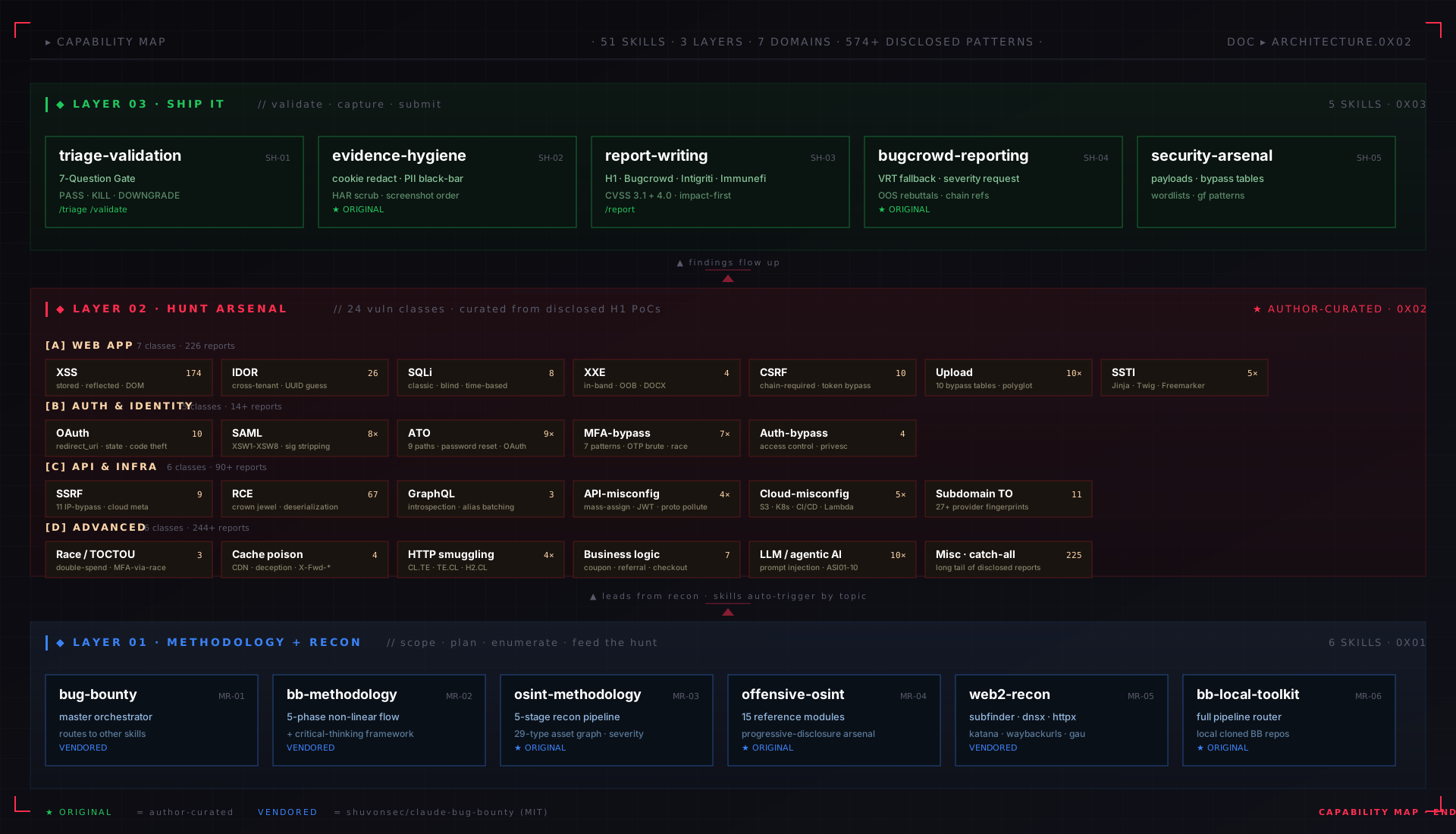
Alternate view — 3-layer capability stack
The same 83 skills, regrouped by role in an engagement rather than by phase. Methodology + Recon (bottom) feeds the Hunt Arsenal (middle), which produces findings that flow up through Ship It (top) to a paid submission or client deliverable.
Alternate view — engagement pipeline with branched outcomes
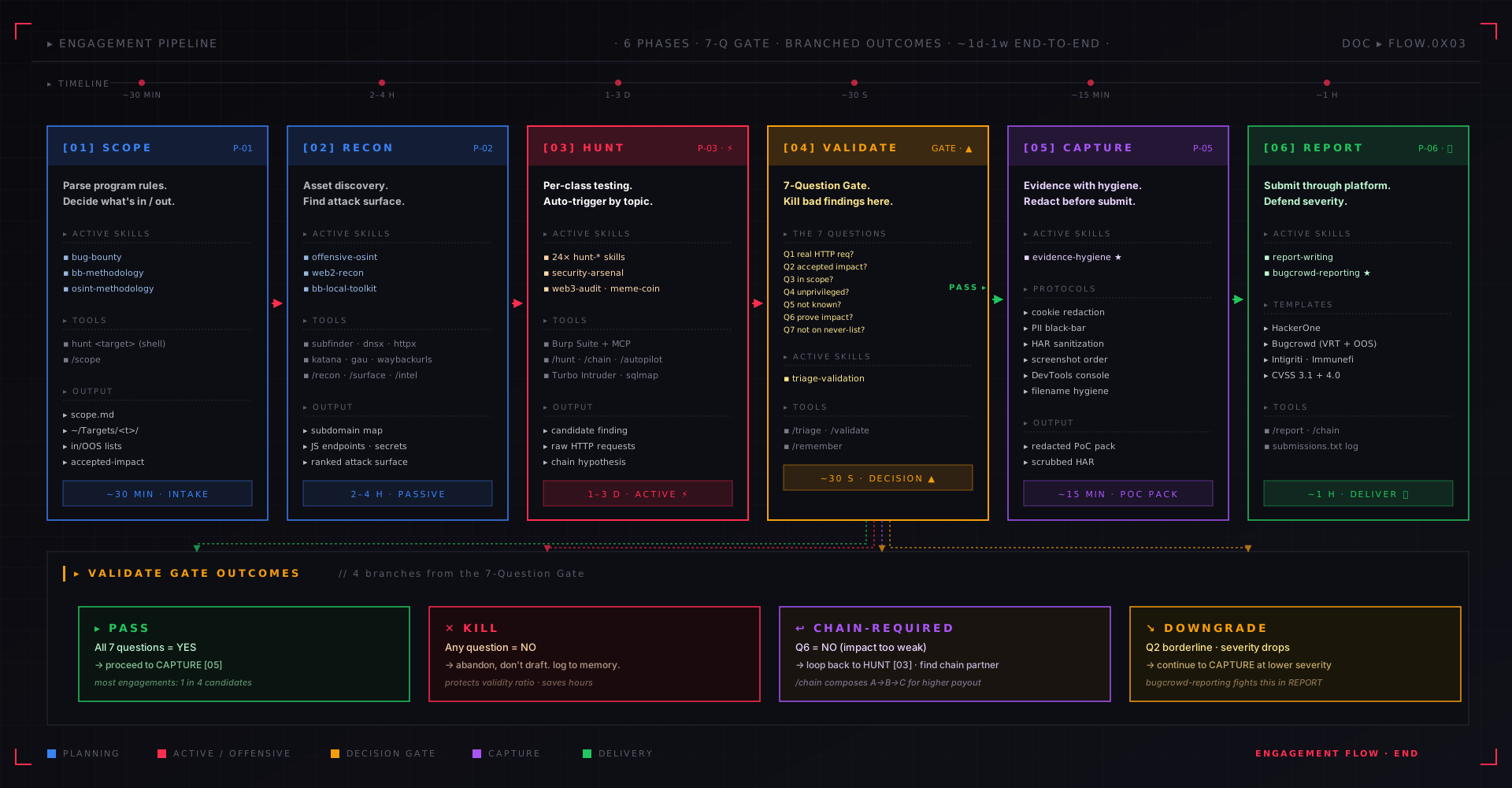
The 6-phase workflow expanded into a pipeline showing per-phase active skills, tools, output, time budgets, and the 4 branched outcomes of the Validate gate (PASS · KILL · CHAIN-REQUIRED · DOWNGRADE).
Phase 1 — SCOPE (program intake, planning)
Use when: starting a new program, parsing scope, deciding what’s in/out
| Skill | Source | Purpose |
|---|---|---|
bug-bounty | vendored | Master orchestrator — pulls in other skills as needed |
bb-methodology | vendored | 5-phase workflow + hunting mindset |
osint-methodology | original | Recon framework, 29-type asset graph, time budgeting |
bb-local-toolkit | original | Full pipeline router for local cloned bug-bounty repos |
hunt <target> (shell) | original | Scaffolds ~/Targets/<name>/ with full template |
Phase 2 — RECON (discovery)
Use when: asset enumeration, subdomain discovery, secret hunting, identity-fabric mapping
| Skill | Source | Purpose |
|---|---|---|
offensive-osint | original | 15-reference probe/regex/dork arsenal — loads on demand |
recon-scope-triage | original | On receiving an ASM/recon dataset — ownership & namespace-collision dedup, in-scope triage before testing |
web2-recon | vendored | Subdomain enumeration, host discovery, URL crawling |
bb-local-toolkit | original | Routes to local cloned bug-bounty repos when applicable |
Phase 3 — HUNT (active testing)
Use when: testing for specific vulnerability classes
| Skill | Source | Purpose |
|---|---|---|
58 hunt-* skills | original + community | Per vuln class / framework, curated from disclosed H1 reports + v3 community expansion — auto-trigger by topic |
security-arsenal | vendored | Payload library (XSS / SSRF / SQLi / SSTI / etc.) |
web3-audit | vendored | Smart-contract audit (10 bug classes, Foundry PoC) |
meme-coin-audit | vendored | Token rug-pull detection |
Per-class hunt skills (58)
hunt-api-misconfig                      hunt-mfa-bypass
hunt-aspnet           (1)               hunt-misc             (225)
hunt-ato                                hunt-nextjs           (19)
hunt-auth-bypass      (12)              hunt-nodejs           (24)
hunt-brute-force      (33)              hunt-nosqli           (14)
hunt-business-logic   (12)              hunt-ntlm-info        (1)
hunt-cache-poison     (10)              hunt-oauth            (19)
hunt-cicd             (18)              hunt-open-redirect    (28)
hunt-cloud-misconfig                    hunt-race-condition   (12)
hunt-cors             (19)              hunt-rce              (67)
hunt-csrf             (15)              hunt-saml
hunt-deserialization  (22)              hunt-session          (18)
hunt-dom              (17)              hunt-sharepoint       (1)
hunt-file-upload                        hunt-source-leak      (31)
hunt-graphql          (12)              hunt-springboot       (16)
hunt-grpc             (6)               hunt-sqli             (12)
hunt-host-header      (16)              hunt-ssrf             (15)
hunt-http-smuggling                     hunt-ssti
hunt-idor             (26)              hunt-subdomain        (15)
hunt-k8s              (13)              hunt-tls-network      (9)
hunt-laravel          (14)              hunt-websocket        (11)
hunt-ldap             (8)               hunt-xss              (174)
hunt-lfi              (31)              hunt-xxe              (10)
hunt-llm-ai

# added this release (all original):
hunt-jwt-crypto                         hunt-forgot-password
hunt-shadow-api                         hunt-exceptional-conditions
hunt-spa-api                            hunt-captcha-bypass
hunt-rag-vector                         hunt-clickjacking
hunt-html-injection                     hunt-fintech-graphql
Plus alternates: hunt-cache-poison, hunt-race-condition, hunt-subdomain. Plus the meta-router hunt-dispatch (used internally by the /hunt slash command — not user-invoked).
Total disclosed reports curated: 681 — 433 now individually cited & auditable across 36 pattern-library files (plus enterprise CVE catalogues that aren’t measured in H1-report counts)
How auto-triggering works: just describe what you’re testing — e.g., “I see a ?url= parameter on this endpoint” — and Claude loads only hunt-ssrf. You don’t invoke them by name.
Enterprise platform attack (Phase 3 expansion — 8 skills)
External red-team engagements against enterprise estates need attack chains for full platform stacks, not just webapps. These 8 skills extend Phase 3 with current 2024-2026 CVE chains and platform-specific tradecraft.
| Skill | Source | Purpose |
|---|---|---|
m365-entra-attack | original | M365 / Entra ID full chain — AADSTS error reference, user enum, Smart Lockout math, CA bypass, ROPC, SAML SSO browser flow |
okta-attack | original | Okta-as-IdP — tenant discovery, factor enum, push fatigue, FastPass abuse, OIDC redirect_uri tampering |
cloud-iam-deep | original | AWS / Azure / GCP IAM priv-esc — STS chaining, IMDS, K8s SA tokens, confused-deputy. Post-credential escalation model. |
vmware-vcenter-attack | original | vSphere / vCenter / Workspace ONE / Aria CVE chain (CVE-2021-21972 → CVE-2024-37085) |
enterprise-vpn-attack | original | Cisco ASA, Fortinet, Citrix NetScaler, PAN GlobalProtect, Pulse/Ivanti, SonicWall, F5 SSL VPN |
apk-redteam-pipeline | original | Android APK red-team pipeline — acquisition → jadx → secret grep → Frida instrumentation |
ios-redteam-pipeline | original | iOS red-team pipeline — IPA acquisition, decryption, class-dump, keychain/ATS/pinning analysis, Frida/objection instrumentation |
supply-chain-attack-recon | original | Dep-confusion, GH Actions injection, SBOM mining, container registry exposure (recon only, no publish-step) |
Red-team tradecraft (cross-phase — 2 skills)
| Skill | Source | Purpose |
|---|---|---|
redteam-mindset | original | Load at the start of any red-team engagement. Operator-discipline corrections separating offensive from defensive WAPT. |
mid-engagement-ir-detection | original | Detect SOC patches mid-test, external attacker activity, baseline shifts → convert observations into deliverable findings |
Phase 4 — VALIDATE (the gate before reporting)
Use when: you think you have a finding — BEFORE drafting any report
| Skill | Source | Purpose |
|---|---|---|
triage-validation | vendored | 7-Question Gate, 4 pre-submission gates, never-submit list |
Slash commands: /triage, /validate
The 7-Question Gate:
- Can an attacker use this RIGHT NOW with a real HTTP request?
- Is the impact on the program’s accepted impact list?
- Is the asset in scope?
- Does it work without privileged access an attacker can’t get?
- Is this not already known or documented behavior?
- Can impact be proved beyond “technically possible”?
- Is this not on the never-submit list?
One NO = KILL. Move on. This single discipline is what separates productive researchers from the noise.
Phase 5 — CAPTURE (evidence hygiene)
Use when: about to take a screenshot, export a HAR, or attach evidence
| Skill | Source | Purpose |
|---|---|---|
evidence-hygiene | original | Cookie redaction, PII black-bar, HAR sanitization, screenshot capture order |
Covered protocols:
- Cookie redaction (which fields, what tools, screenshot timing)
- PII black-bar (other-user data, faces, addresses, SSNs)
- HAR file sanitization (jq filters)
- Burp screenshot hygiene (Repeater, Intruder, Proxy)
- DevTools Console PoC patterns
- Filename conventions for multi-step PoCs
- Post-submission rotation hygiene
Phase 6 — REPORT (submission)
Use when: drafting the final report
| Skill | Source | Purpose |
|---|---|---|
report-writing | vendored | H1 / Bugcrowd / Intigriti / Immunefi templates, CVSS 3.1 + 4.0 |
bugcrowd-reporting | original | Bugcrowd VRT search, severity-request paragraph, OOS rebuttals |
redteam-report-template | original | Client-facing red-team deliverable — Subject / Observations / Description / Impact / Recommendation / PoC. MD + DOCX packaging with embedded screenshots. |
Slash command: /report
Integration layer
Tools the skills call into during the workflow.
| Tool | Purpose |
|---|---|
| Burp MCP | Claude reads/replays HTTP traffic directly from Burp’s proxy history. Eliminates manual paste-curl-into-chat. |
hunt shell command | Engagement-folder scaffold (~/Targets/<name>/CLAUDE.md + scope.md + findings/ + evidence/ + submissions.txt + notes.md + .gitignore). |
| HackerOne API | Used externally with public-skills-builder to refresh hunt-* skill content from newly disclosed reports. |
Composition example — full engagement walkthrough
1. SCOPE
   $ hunt acme-bb              → scaffolds ~/Targets/acme-bb/
   $ cd ~/Targets/acme-bb
   $ claude                    → opens Claude Code in this folder
   "Help me parse the program page into scope.md"
   → triggers bb-methodology, populates scope.md

2. RECON
   "Run external recon on *.acme.com"
   → triggers offensive-osint + web2-recon
   → suggests: certificate transparency, JS endpoint extraction, S3 enum

3. HUNT
   "I see /api/users/{id}/orders in JS — testing IDOR with two test accounts"
   → triggers hunt-idor
   → walks through detection patterns, payloads, two-account verification

4. VALIDATE
   /triage
   "I get back the victim's order data when I change the user_id"
   → 7-Question Gate
   → returns PASS (assuming all checks pass)

5. CAPTURE
   "About to take a screenshot of the IDOR PoC"
   → triggers evidence-hygiene
   → reminds you to redact cookies, mask victim PII

6. REPORT
   /report
   → triggers report-writing + bugcrowd-reporting
   → produces ready-to-paste body + VRT mapping + severity request paragraph
Skill-loading mechanics
Auto-trigger: Skills load when their description matches your prompt. The skill matcher uses the description field in the YAML frontmatter.
Progressive disclosure: Large skills (e.g., offensive-osint) keep SKILL.md lean and put detailed reference content in subfolders that load only when needed.
Slash commands: Some skills have explicit slash-command invocations (/triage, /validate, /report, /recon, /hunt, /scope, etc.) that force-load the relevant skill.
What’s NOT in the bundle (intentional gaps)
- No automated exploitation tooling — this bundle guides hunting and reporting; it doesn’t fire payloads automatically. Use Burp’s Active Scanner, sqlmap, etc. for automated work.
- No CI/CD integration — this is a workflow stack for individual researchers, not a continuous scanning pipeline.
- No secret leak deletion — if the stack helps you find leaked credentials, you (and the program) handle remediation.
- Mobile covered on both platforms —
apk-redteam-pipeline(Android) andios-redteam-pipeline(iOS) cover mobile red-team recon and instrumentation; deep runtime work can still pair withMobile-Security-Framework-MobSFor Burp Mobile Assistant.
Further reading
- USAGE.md — full usage walkthrough with worked example
- INSTALL.md — step-by-step setup
- docs/credits.md — full attribution to upstream sources
- shuvonsec/claude-bug-bounty — vendored foundation